Agent Orange: Landscape, Body, Image
Conference and Exhibit
University of California, Riverside
California Museum of Photography
May 02, 2009 - August 29, 2009
Opening Reception: May 02, 6:00 PM - 9:00 PM
Agent Orange: Landscape, Body, Image features photographs and installations by Goro Nakamura, Dinh Q. Lê, Doan Duc Minh, and Binh Danh. Since the 1960s, Agent Orange has come to symbolize the widespread tragedy of war and its silent legacies that persist for generations in damaged ecosystems and in the genetic and social landscapes of human bodies in Vietnam and elsewhere. The artists explore through images the enduring in/visibility of dioxin as it continues to mark both landscape and body. Curated by Lan Duong, Assistant Professor, Media and Cultural Studies, UC Riverside and Christina Schwenkel, Assistant Professor, Anthropology, UC Riverside.
A 3-day conference in association with the exhibit will take place on May 7 - 9, 2009, and will feature keynote presentations and a panel discussion with the artists, along with film screenings. Events and exhibition organized by UCR Professors Christina Schwenkel, David Biggs, and Lan Duong. Sponsored by the UC Pacific Rim Research Foundation, SEATRiP, Center for Ideas and Society, and the Department of Media and Cultural Studies.
For more information, see: http://www.seatrip.ucr.edu/
http://www.cmp.ucr.edu/
Showing posts with label conference. Show all posts
Showing posts with label conference. Show all posts
25 March 2009

28 May 2008
CFP: Asian American Theatre Group
Asian American Theatre Group
American Society for Theatre Research
2008 Conference
Co-conveners:
Esther Kim Lee, University of Illinois, Urbana-Champaign (kim32@uiuc.edu)
Ron West, Metropolitan Community College, Omaha, NE (rwest33449@aol.com)
Asian American theatre, as an investigatory category, offers a particularly appropriate opportunity to explore the implications of migration across and within geopolitical borders and cultural boundaries. Though "migration" generally implies a willing movement of people among geographic areas, it also provides a convenient euphemism for the manipulative consequences of globalization. Thus, "migrant" populations may be compelled or encouraged to move among geographic regions but remain excluded from full membership in "settled" social and political territories such as the Americas. The borders are economically fluid, but culturally unyielding. In particular, Asian populations historically have been excluded by convention and statute from full membership in the "American" imagination, even while the! y have been exploited as economic necessities and defined as the Other. Asian American theatre likewise struggles with the relegation to contingency status, signaled by its persistent depiction as a component of the mid-twentieth century's countercultural movement, a sidebar to the main event. Still, Asian American theatre broadly defined remains one of the most promising sites for challenging the false dichotomy of "Asian" and "American" that continues to define the constructed representation of the Asian diaspora in the Americas.
Our group invites participants to address the ways in which the migration, map, and memory of Asian American theatre unsettles "American" theatre by re-settling the territory between the illusory poles of Asia and the Americas. As the first ASTR session to focus on Asian American theatre, the meeting will allow participants to explore the potential o! f Asian American theatre as a web of links rather than a series of discrete "ethnic" discourses and thereby to examine a range of interstitial relationships that avoid isolating Asian American, yet retain a productive distinction. In part because of our hope to draw upon a broad community of perspectives, we especially encourage submissions that extend Asian American beyond the American subdivision of the United States.
Session format:
The process and implementation of the session will resemble the ASTR seminar's 2-hour structure. Participants must commit to submitting preliminary drafts of their papers by August 1st and actively participate in an online pre-conference discussion by means of a fully secure website. The final conference drafts (8-10 pages) are due by October 15th.
By June 6, 2008 please submit an abstract (max 500 words) and brief biography (150 words) via email to:
Esther Kim Lee, University of Illinois, Urbana-Champaign (kim32@uiuc.edu)
AND
Ron West, Metropolitan Community College, Omaha, NE (rwest33449@aol.com)
American Society for Theatre Research
2008 Conference
Co-conveners:
Esther Kim Lee, University of Illinois, Urbana-Champaign (kim32@uiuc.edu)
Ron West, Metropolitan Community College, Omaha, NE (rwest33449@aol.com)
Asian American theatre, as an investigatory category, offers a particularly appropriate opportunity to explore the implications of migration across and within geopolitical borders and cultural boundaries. Though "migration" generally implies a willing movement of people among geographic areas, it also provides a convenient euphemism for the manipulative consequences of globalization. Thus, "migrant" populations may be compelled or encouraged to move among geographic regions but remain excluded from full membership in "settled" social and political territories such as the Americas. The borders are economically fluid, but culturally unyielding. In particular, Asian populations historically have been excluded by convention and statute from full membership in the "American" imagination, even while the! y have been exploited as economic necessities and defined as the Other. Asian American theatre likewise struggles with the relegation to contingency status, signaled by its persistent depiction as a component of the mid-twentieth century's countercultural movement, a sidebar to the main event. Still, Asian American theatre broadly defined remains one of the most promising sites for challenging the false dichotomy of "Asian" and "American" that continues to define the constructed representation of the Asian diaspora in the Americas.
Our group invites participants to address the ways in which the migration, map, and memory of Asian American theatre unsettles "American" theatre by re-settling the territory between the illusory poles of Asia and the Americas. As the first ASTR session to focus on Asian American theatre, the meeting will allow participants to explore the potential o! f Asian American theatre as a web of links rather than a series of discrete "ethnic" discourses and thereby to examine a range of interstitial relationships that avoid isolating Asian American, yet retain a productive distinction. In part because of our hope to draw upon a broad community of perspectives, we especially encourage submissions that extend Asian American beyond the American subdivision of the United States.
Session format:
The process and implementation of the session will resemble the ASTR seminar's 2-hour structure. Participants must commit to submitting preliminary drafts of their papers by August 1st and actively participate in an online pre-conference discussion by means of a fully secure website. The final conference drafts (8-10 pages) are due by October 15th.
By June 6, 2008 please submit an abstract (max 500 words) and brief biography (150 words) via email to:
Esther Kim Lee, University of Illinois, Urbana-Champaign (kim32@uiuc.edu)
AND
Ron West, Metropolitan Community College, Omaha, NE (rwest33449@aol.com)
21 April 2008
Conference Photographs!
Check out some of the photographs from the Southeast Asians in the Diaspora conference here. If you have more, please leave a note in the comments!
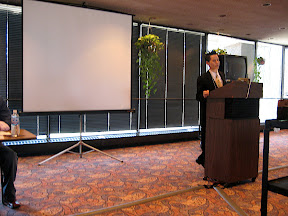
Southeast Asians in the Diaspora Conference, 15-16 April
The second (and successful) Southeast Asian/American studies conference was held this past week at the University of Illinois, Urbana-Champaign, hosted by the Asian American Studies Program and coinciding with the annual Association of Asian American Studies meeting in Chicago. This blog emerges out of the conference as a collaborative project tracking the field of Southeast Asian/American studies, collecting links, resources, and research for students, scholars, community organizations, and artists working in (and sometimes around) cultural and intellectual production about the categories and queries collected loosely, and sometimes uneasily, under the rubric of "Southeast Asians in the diaspora."
The exact contours of this project are still in development; for now, here is the 2008 conference site and our overview, as follows:
The exact contours of this project are still in development; for now, here is the 2008 conference site and our overview, as follows:
This two-day conference examines the emerging field of Southeast Asian/American studies, which because of specific histories of colonialism and imperialism, has produced subjects and objects of analysis that confound categories of diaspora, citizenship, and affiliation. Studies of the Cambodian, Laotian, and Vietnamese diasporas investigate and trouble the structuring effects of Cold War geopolitics; while studies of Hmong, Mien, Cham, and other stateless ethnicities necessarily reconsider the bases for global and local practices of identification as well as strategic claims to rights and resources.
Given this, the field foregrounds important epistemological and methodological shifts that productively disrupt the analytic conventions of area studies, American studies, ethnic studies, and Asian American studies. Thinking across these fields, Southeast Asian/American studies fulfills the intellectual and political promise of what Kandice Chuh imagines as "studies in comparative racialization and intersectional projects that deliberately unravel seemingly stable distinctions among identificatory categories and disciplinary divisions." Complicating the examination of nationalisms and transnationalisms, Southeast Asian/American studies questions the circulation of, the negotiation with, or challenges to the knowledge regimes of U.S. nation and empire.
Subscribe to:
Posts (Atom)